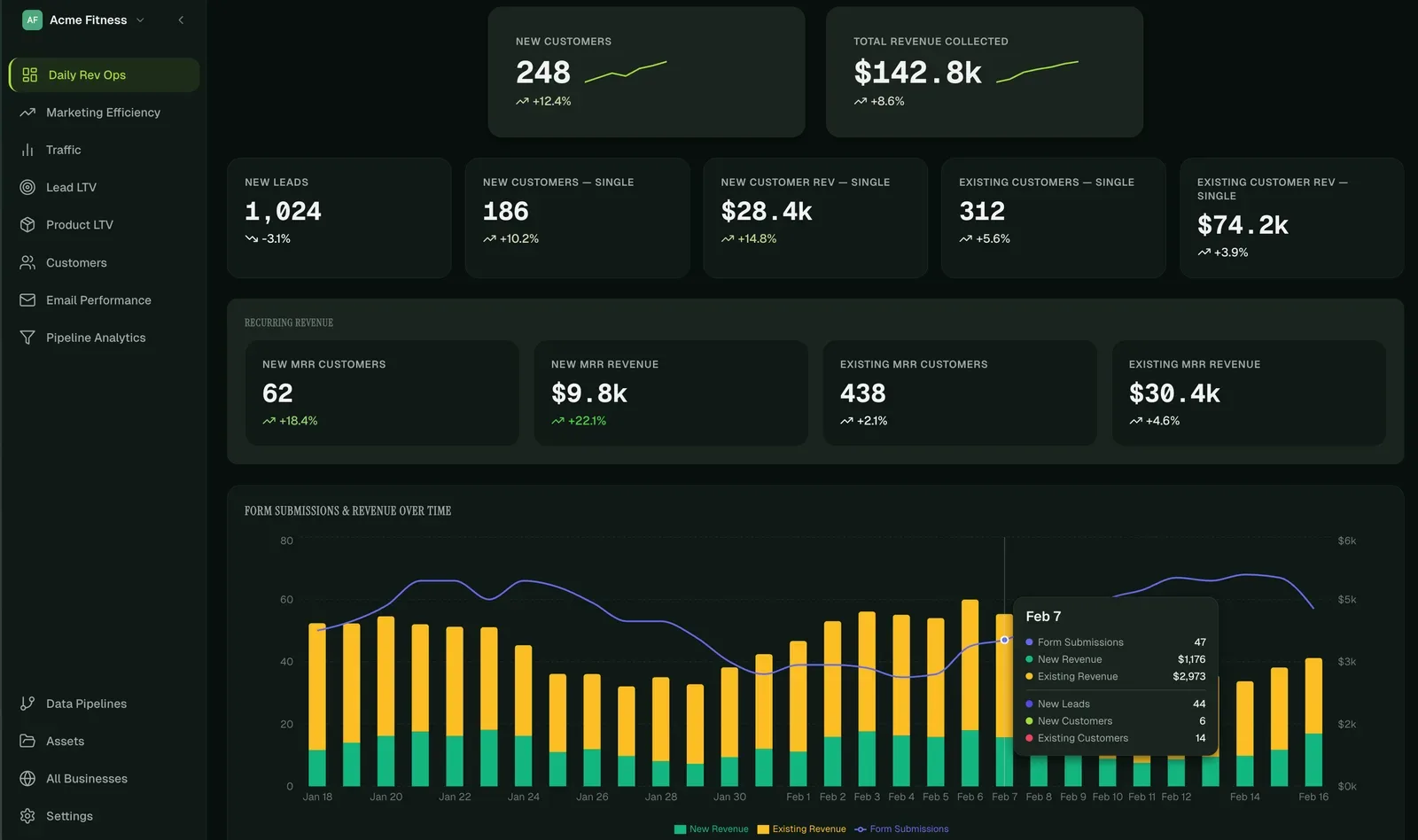
If you run paid ads to GHL funnels, you probably need Hello Conversions. It's the tool that fixes the actual problem most people have, which is server-side conversion data flowing into Meta and Google and creating the right visualizations that answer business questions.
If you have a high-AOV info product with long sales cycles, look at Hyros or Wicked Reports. They build their own attribution database. Most people don't need this and end up coming back to a server-to-server setup anyway.
If you need custom dashboards, stream your GHL data into BigQuery and build whatever you want in Looker Studio or PostHog.
That's the whole guide. Everything below is context.
The two ways to fix GHL reporting
There are basically two philosophies. Pick one before you start comparing tools.
Option 1: Send better data to the ad platforms
You trust Meta and Google to do attribution. You just feed them complete, accurate, server-side data so their algorithms can optimize properly.
Every time a contact moves through pipeline stages in GHL (new lead, booked call, qualified, closed) the tool sends that event server-to-server to Meta Ads, Google Ads, and any analytics tool you use.
It's cheap. It's simple. It doesn't ask you to learn a new attribution UI. The tradeoff is that you read your results inside Meta Ads Manager and Google Ads, not in some unified dashboard.
Tools that work this way: Hello Conversions, Stape, Whalesync, Elevar.
Option 2: Build your own attribution database
You assume ad platform attribution is broken beyond fixing. You rebuild attribution from scratch with your own tracking, your own database, and your own model.
Now you have one dashboard with cross-channel ROAS and multi-touch attribution. Sounds great until you realize their numbers disagree with Meta and Google, and now you have to decide who to trust every time you make a decision.
Tools that work this way: Hyros, Wicked Reports, Microports.
Most GHL users overestimate how badly they need Option 2. Real talk from JJ: people want it to do more, like a Hyros. But once they use Hyros and they don't like it, they come back to Hello Conversions. The problem most people are calling an attribution problem is actually a server-side tracking problem. Fix that first.
Hello Conversions: best for sending accurate GHL pipeline data to Meta and Google
It connects to GHL directly and streams every pipeline stage event server-to-server into Meta Ads, Google Ads, and PostHog. New lead. Booked call. Qualified. Closed. Each one shows up as a tracked event in your ad platforms with 100% accuracy because there's no pixel or browser involved.
Pricing starts around $40 a month. The custom data infrastructure tier (which streams every GHL data point into BigQuery so you can build any dashboard you want) is around $500 a month.
It was built by VisionLabs because they were running into the same issue with every client. The integration handles all the weird stuff GHL does, custom pipelines, opportunities versus contacts, stage changes, all of it.
The catch: there's no built-in dashboard. You read your numbers inside Meta Ads Manager, Google Ads, or whatever analytics tool you have. If you want a unified attribution UI, you'll add BigQuery and Looker Studio on top.
My take: Full disclosure, I built this. I built it because I was tired of explaining to clients why their Meta numbers didn't match GHL. If you're running ads to GHL and you don't have server-to-server tracking, Meta is optimizing on garbage data. This is the cheapest way to fix that. Start here, then decide if you need anything else on top.
Hyros: best for high-AOV info products with long sales cycles
Hyros builds its own attribution database. It tracks every visitor, ties them to GHL contacts via email match, and runs proprietary attribution across Meta, Google, YouTube, email, and organic. You get a single dashboard with cross-channel ROAS.
It starts around $499 a month and goes up fast based on ad spend. Enterprise plans run $2k+ a month.
Best fit is coaches, course creators, agencies selling $5k+ packages, anything where one closed deal pays for the tool ten times over.
The honest tradeoff: Hyros frequently disagrees with Meta and Google attribution numbers. If you trust their model, that's fine. But you're now running ads while reading two contradictory sets of data, and that's a real cognitive load.
My take: Hyros isn't a bad tool. It's just sold to a lot of people who don't actually need it. I see the same pattern over and over. Someone with a $200 AOV product hears Hyros pitched as the answer to all their attribution problems, pays $500 a month for six months, gets buried in conflicting dashboards, and switches back to a server-side setup. If you're not selling $5k+ products, skip it.
Wicked Reports: best for email-heavy direct response businesses
Same architecture as Hyros. Independent attribution database with cross-channel reporting. The main difference is a heavier focus on email and lifetime value attribution.
Best fit is email-heavy direct response, ecommerce plus funnel hybrid businesses, or long-cycle B2B with strong list nurturing. Pricing starts around $300 a month.
Same tradeoff as Hyros. Proprietary model, constant reconciliation with the ad platforms.
My take: Wicked Reports is the better pick than Hyros if email is your real attribution problem. Their LTV modeling is genuinely useful for businesses with long buyer journeys. But if you're picking between Wicked Reports and Hyros, you've already decided you want a dedicated attribution database, and that's a bigger decision than which one. Make sure you actually need that before signing up.
Stape: best for ecommerce stores running GHL alongside Shopify
Server-side Google Tag Manager hosting plus conversion API forwarding. Pairs with GHL when you have a Shopify or custom storefront alongside the CRM.
Stape is more of a Shopify and web tool than a GHL-native tool. If you have GHL only, you don't need Stape. If you have Shopify plus GHL, you'll often run Stape and Hello Conversions together. Stape handles the website side. Hello Conversions handles the GHL side.
$20 to $100 a month depending on event volume.
My take: Stape is solid for what it does. The mistake people make is thinking it replaces a GHL-specific tool. It doesn't. If you're GHL-only, Stape is overkill. If you're running ecommerce plus GHL, it's part of the stack, not the whole stack.
PostHog: best for SaaS and membership businesses with a logged-in product
PostHog is product analytics. Heatmaps, funnels, session recordings, feature flags, experimentation. When you pair it with Hello Conversions, every GHL pipeline stage shows up in PostHog as a tracked event with 100% accuracy.
Best fit is SaaS or membership businesses where users have a logged-in product after the GHL funnel. You can combine ad data, funnel data, and in-product behavior in one tool, which most analytics setups can't do.
Free up to 1M events a month. Most GHL businesses pay $97 to $1,200 a month.
PostHog is not a GHL-native tool. You need Hello Conversions or something equivalent to bridge GHL events into PostHog.
My take: PostHog is the best product analytics tool out right now and we use it on most of our enterprise implementations. But it's the wrong tool if you're a service business with no logged-in product. People hear me talk about PostHog and assume they need it. Most of them don't. If your customer journey ends at "booked a call," PostHog is way more tool than you need.
Looker Studio plus BigQuery: best for agencies and teams that want custom dashboards on a budget
Looker Studio (formerly Google Data Studio) is a free dashboard tool. BigQuery is a data warehouse. Hello Conversions can stream every GHL data point into BigQuery, and from there you can build any GHL dashboard you can imagine in Looker Studio.
Looker Studio is free. BigQuery costs $5 to $200 a month for most GHL businesses. Hello Conversions data infrastructure is around $500 a month on top.
This is what you want if you're running an agency that delivers branded reporting to clients, or if you're combining GHL plus Meta plus Google plus Shopify plus email into one executive dashboard.
The downside is that Looker Studio gets slow with large datasets and the interactivity is limited.
My take: Looker Studio is free, and it shows. It's slow, the interactions are clunky, and it'll frustrate anyone who's used a real BI tool. But it's still the right answer for most GHL users who need custom dashboards because the alternatives cost 10x more. Use it until the slowness costs you more than upgrading would.
VisionLabs Reporting Suite: best for enterprise teams running 6-figure monthly ad spend
A done-for-you reporting layer that sits on top of your GHL data warehouse. Faster than Looker Studio, more interactive, with AI-powered Q&A on your data so a marketer can ask "which campaign drove the most closed deals last month" and get an answer without writing SQL.
This isn't a self-serve product. It's the deliverable of a managed analytics retainer with VisionLabs, typically $4,500 a month or more. It makes sense for companies running 6-figure monthly ad spend where reporting failures cost more than the tool.
My take: Honest disclosure again, this is ours. We built it because Looker Studio was the bottleneck for our enterprise clients. If you're spending $50k+ a month on ads, the cost of a bad reporting decision is way more than $4,500. If you're not at that scale yet, this isn't for you. Stick with Looker Studio until your team is making real money decisions off the dashboard every day.
How to actually decide
If you're not sure where to start, answer these in order. The first yes picks your tool.
Are you running paid ads to GHL funnels?
Get Hello Conversions first. Don't even look at attribution tools until your server-to-server tracking is solid. Broken pixel tracking is the single biggest reason ads underperform, and Hyros can't fix that for you.
Is your AOV above $5k and your sales cycle longer than 30 days?
Now you can layer in Hyros or Wicked Reports if you want a dedicated attribution model. But put Hello Conversions in first so the model has clean data to work with.
Do you have a logged-in product after the funnel?
Add PostHog. Hello Conversions feeds GHL events into it automatically.
Do you need branded executive dashboards?
Stream GHL data into BigQuery and build in Looker Studio. Free, with some patience for load times.
The 3 mistakes most GHL users make
Buying Hyros before fixing pixel tracking.
Hyros can't fix what server-to-server tracking solves. Without clean data feeding the ad platforms, your campaigns still optimize against incomplete information, and Hyros' model is also less accurate. Fix the foundation, then layer attribution on top.
Treating GHL native reporting as a single source of truth.
GHL's dashboards are good for pipeline volume but blind to ad performance. You'll make confident-sounding decisions about which channel is working, based on data missing 30% of the picture.
Buying the tool but never using it.
The most successful GHL businesses don't just have reporting. They have a daily ritual where the team looks at the numbers and changes something. Bot Builders does this every morning. Their entire marketing team meets, opens the report, and decides what to do that day. Jeff Walker has the exact same data and does nothing with it. Same tool. Different outcomes by an order of magnitude. The tool isn't the moat. The operating cadence is.
Bottom line
For most GHL users running paid ads, Hello Conversions is the right starting point. It's cheap, it solves the actual problem, and it doesn't ask you to learn a whole new attribution model just to fix what was always a tracking problem.
Add Hyros or Wicked Reports if your AOV and sales cycle genuinely justify it. Add PostHog if you have a product. Stream to BigQuery if you need custom dashboards.
The biggest mistake isn't picking the wrong tool. It's picking an expensive one to solve a problem that a $40 a month server-to-server integration would have fixed cleaner.